Introduction
Digital transformation is more than adopting new technology—it is a fundamental shift in how organizations operate, deliver value, and compete in the digital economy. Successful transformation requires a clear vision, a practical roadmap, and the commitment to change across every level of the organization.
This article provides a practical roadmap for digital transformation, covering the key technologies, strategic considerations, and implementation practices that drive sustainable success.
What Is Digital Transformation?
Digital transformation is the integration of digital technology into all areas of a business, fundamentally changing how organizations operate and deliver value to customers. It's not just about upgrading systems—it's about reimagining business models, processes, and customer experiences for the digital age.
Successful digital transformation touches every aspect of an organization:
- Customer Experience: Delivering personalized, seamless interactions across all channels.
- Operational Agility: Using data and automation to respond quickly to changing conditions.
- Workforce Enablement: Equipping employees with tools and insights to work more effectively.
- Technology Modernization: Moving from legacy systems to flexible, cloud-native platforms.
Key Technologies Driving Digital Transformation
Several foundational technologies enable digital transformation:
1. Cloud Computing
Cloud platforms provide the scalability, flexibility, and cost-efficiency needed to support modern digital applications and services.
2. Data & Analytics
Data-driven insights enable better decisions, personalized experiences, and operational optimization.
3. Artificial Intelligence
AI and machine learning automate processes, predict outcomes, and unlock new capabilities across the organization.
4. API-First Integration
APIs connect systems, enable ecosystem partnerships, and allow organizations to compose solutions from modular capabilities.
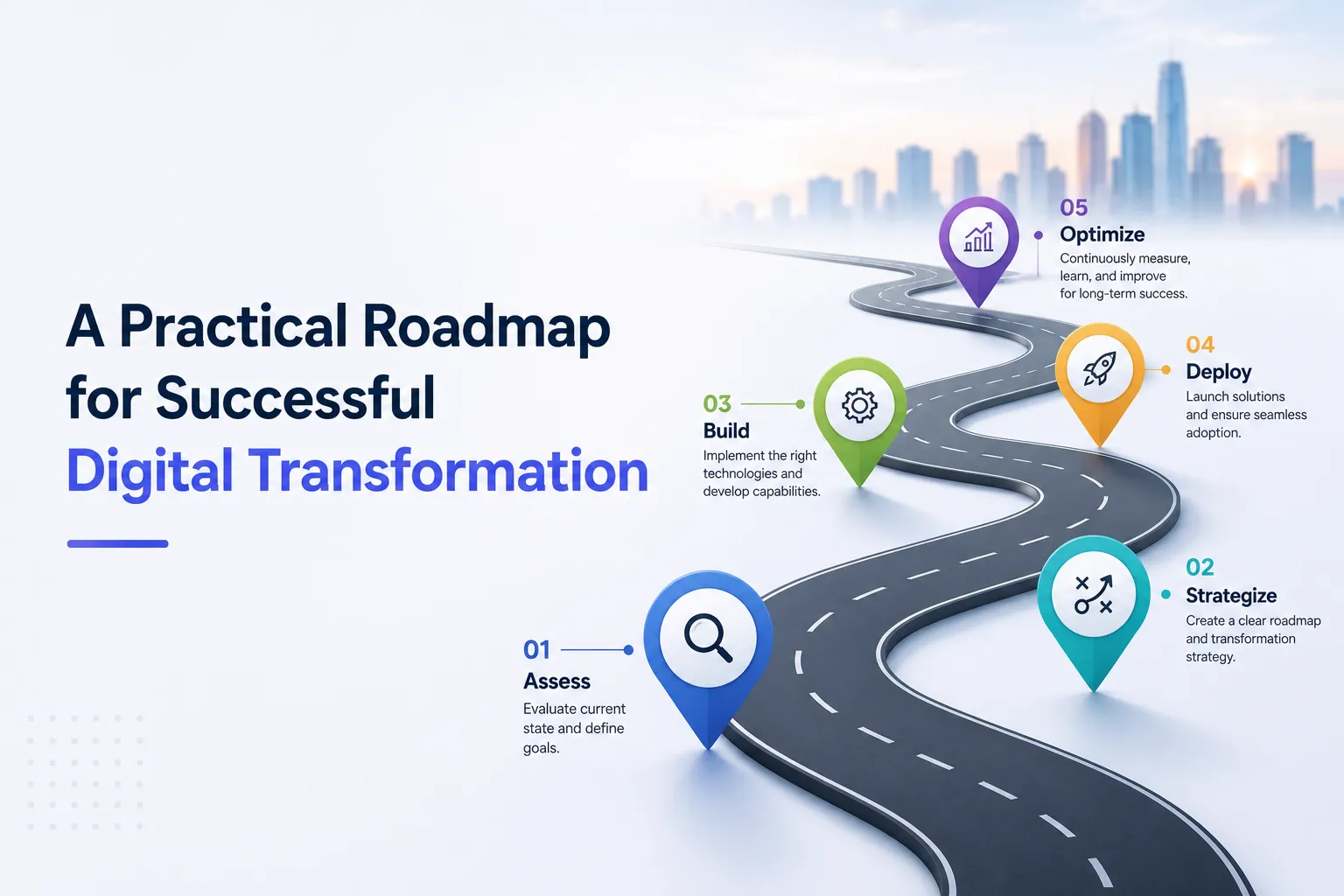
A Practical Digital Transformation Roadmap
Digital transformation is a journey, not a destination. Here is a practical, phased approach:
Phase 1: Assessment & Strategy
- Evaluate Current State: Assess existing systems, processes, and capabilities.
- Define Business Goals: Identify specific outcomes you want to achieve.
- Prioritize Initiatives: Focus on high-impact, low-risk opportunities first.
Phase 2: Foundation Building
- Modernize Core Systems: Migrate critical applications to cloud-native architectures.
- Establish Data Infrastructure: Build data pipelines and governance frameworks.
- Implement Security & Compliance: Embed security practices from the start.
Phase 3: Scaling & Optimization
- Expand Digital Capabilities: Add AI, automation, and advanced analytics.
- Enable Self-Service: Empower business users with tools and data access.
- Optimize Processes: Continuously improve through feedback and data.
Phase 4: Innovation & Growth
- Explore New Business Models: Identify opportunities for digital products and services.
- Build Ecosystem Partnerships: Leverage APIs to create new value chains.
- Foster a Culture of Innovation: Encourage experimentation and continuous learning.
Start small and scale fast: Begin with a pilot project to demonstrate value, then expand based on lessons learned and proven success.
Change Management: The Human Side of Transformation
Technology is only half the equation. People and culture are equally critical to digital transformation success:
- Executive Sponsorship: Leadership commitment is essential to drive change.
- Communication: Clearly articulate the vision, benefits, and progress.
- Training & Enablement: Equip employees with the skills they need.
- Celebrate Wins: Recognize and share early successes to build momentum.
Don't underestimate cultural resistance. Change management is often the most challenging and most important part of any transformation initiative.
Case Study: Healthcare Provider Modernization
A regional healthcare provider embarked on a digital transformation journey to improve patient outcomes and operational efficiency. By modernizing their systems and processes, they achieved significant improvements:
By implementing a cloud-based platform with integrated analytics, the provider enabled real-time patient data access and automated administrative workflows, resulting in better care coordination and reduced costs.
Measuring Digital Transformation Success
Define clear metrics to track progress and demonstrate value:
- Operational Metrics: Efficiency gains, cost reduction, cycle time improvements.
- Customer Metrics: Net Promoter Score (NPS), customer satisfaction, retention.
- Technology Metrics: Deployment frequency, system uptime, scalability.
- Financial Metrics: Revenue growth, cost savings, return on investment.
Future Trends in Digital Transformation
Digital transformation continues to evolve. Key trends to watch:
- AI-Integrated Operations: AI will become embedded in every business process.
- Composable Business: Organizations will assemble capabilities from modular, interchangeable components.
- Data Mesh: Decentralized data architectures that empower domain teams.
- Sustainable Technology: Green IT and carbon-aware computing will become priorities.
Conclusion
Digital transformation is a journey that requires vision, commitment, and a practical roadmap. By focusing on business outcomes, adopting modern technologies, and investing in people and culture, organizations can build a resilient, agile foundation for the future.
At Insoft, we partner with organizations to guide them through every stage of digital transformation—from strategy and architecture to implementation and optimization. Our engineering teams bring deep technical expertise and a focus on delivering measurable business value.
“Digital transformation is not about technology—it's about changing how organizations think, work, and create value.”