Introduction
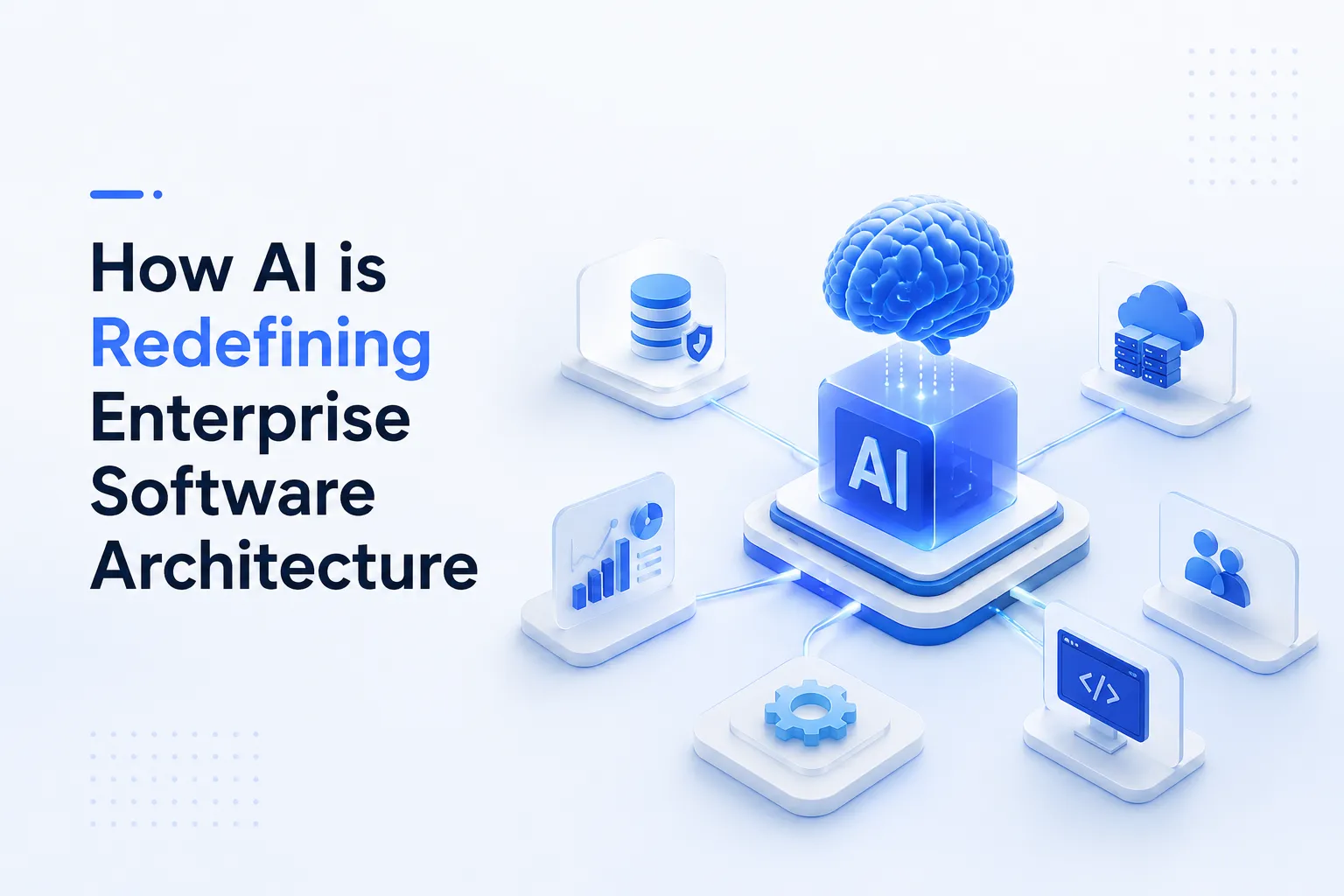
Artificial intelligence is no longer a futuristic concept—it is a practical tool that enterprises are integrating into their software architectures to gain competitive advantage. From intelligent automation and predictive analytics to natural language processing and computer vision, AI capabilities are becoming standard features in enterprise applications.
This article explores how AI is transforming enterprise software architecture, the key architectural patterns that enable AI integration, and the practical considerations for organizations looking to adopt AI at scale.
The Role of AI in Modern Enterprise Systems
AI is not a single technology but a collection of capabilities that can be applied across various domains:
- Intelligent Automation: Robotic process automation (RPA) combined with AI to automate complex business processes.
- Predictive Analytics: Using machine learning models to forecast demand, detect anomalies, and optimize operations.
- Natural Language Interfaces: Chatbots, virtual assistants, and voice-enabled applications for customer and employee interactions.
- Computer Vision: Image and video analysis for quality control, security, and document processing.
- Recommendation Engines: Personalizing user experiences based on behavioral data.
Architectural Patterns for AI Integration
Integrating AI into enterprise software requires careful architectural planning. Common patterns include:
1. AI as a Service (AIaaS)
Cloud providers offer pre-trained AI models and APIs (e.g., AWS SageMaker, Azure Cognitive Services). These services reduce the need for in-house data science expertise.
2. Embedded AI
AI models are embedded directly into application logic, often using on-device inference for low-latency scenarios common in mobile and edge applications.
3. Event-Driven AI
AI models are triggered by events (e.g., new data arriving) and produce insights or actions consumed by other services via message queues.
4. Microservices for AI
Each AI capability is exposed as a standalone microservice, scaling independently and enabling teams to update models without affecting the whole system.
Design for model drift: Monitor model performance in production and implement retraining pipelines to maintain accuracy over time.
Data Architecture for AI
AI models are only as good as the data they are trained on. Enterprise data architecture must support:
- Data ingestion: Collecting data from multiple sources (databases, APIs, IoT devices, logs).
- Data storage: Using data lakes or warehouses for scalable storage and analytical queries.
- Data pipelines: ETL/ELT processes that clean, transform, and aggregate data for training.
- Feature store: A centralized repository for features used in training and inference.
- Data governance: Ensuring data quality, privacy, and compliance (GDPR, CCPA, etc.).
Security and Privacy Considerations
AI introduces unique security challenges:
- Model poisoning: Attackers can introduce malicious data during training to alter model behavior.
- Inference attacks: Extracting sensitive information from model outputs.
- Data privacy: Protecting personally identifiable information (PII) used in training.
Always encrypt data at rest and in transit. Implement strict access controls and audit logging for AI pipelines.
Real-World Impact
Enterprises are using AI in diverse ways to drive business value:
A global logistics company implemented AI-driven route optimization, resulting in significant cost savings and improved customer satisfaction. This demonstrates the tangible ROI of integrating AI into core business processes.
Future Trends
The evolution of AI in enterprise architecture will be shaped by:
- Generative AI: Code generation, automated testing, and intelligent documentation will boost developer productivity.
- Federated learning: Training models across distributed data sources without centralizing sensitive data.
- Explainable AI (XAI): Building trust by making model decisions transparent and interpretable.
- AI observability: Monitoring model performance, fairness, and bias in production.
Conclusion
Artificial intelligence is fundamentally changing how enterprise software is designed, developed, and operated. Organizations that embrace AI as a core architectural component will be better positioned to innovate, automate, and adapt in a rapidly changing business landscape.
At Insoft, we help enterprises integrate AI into their software systems through custom development, cloud-native architectures, and data engineering. Our team combines software engineering excellence with AI expertise to deliver scalable, secure, and intelligent solutions.